What is Bankability for Utility-Scale Solar and 4 Reasons Why Investors Trust PlantPredict's Results
Securing financing from lenders or investors for a utility-scale solar project requires more than a convincing pitch — it requires solid evidence. You must prove that your energy yield estimates are accurate, your financial projections are dependable, and that the technology, site conditions, and operational assumptions align with reality.
This essential evidence is referred to as "bankability" in the utility-scale solar industry. When it comes to predicting energy yield, PlantPredict consistently delivers results investors can trust.
In this post, we'll dive into the essentials of bankability for utility-scale solar projects and explore the four key pillars that establish PlantPredict's credibility with lenders, investors, and independent engineers:
First Solar Heritage: Built for Utility-Scale Reality
Third-Party Validation: Reviewed by Top IEs
Over 3 Terawatts Simulated: Real-World Confidence
Award-Winning Accuracy: PVPMC Blind Modeling Wins
All You Need to Know About Bankability in Utility-Scale Solar
What is Bankability for Utility-Scale Solar?
In the context of utility-scale solar projects, bankability refers to the level of confidence that investors, lenders, and insurers have in a project's ability to perform as expected and generate consistent returns.
It's not merely a measure of technical quality or financial potential — it's a holistic indicator of trustworthiness, predictability, and risk-adjusted viability. In short, for a utility-scale solar project, bankability can be the difference between a signed term sheet and a stalled development.
Why Does Bankability Matter in Utility-Scale Solar?
When it comes to utility-scale solar development, bankability is key to financial health. It indicates how much confidence investors, lenders, and insurers have in a project's potential to meet expectations over time. A project that is deemed highly bankable not only attracts funding but also secures it under more advantageous terms — this helps lower costs, speed up timelines, and enhance long-term profitability.
Here are 4 reasons why bankability is so critical for utility-scale solar projects:
Unlocks Access to Capital: Utility-scale solar projects require significant upfront investment. Bankability helps de-risk that capital by proving the project's technical and financial credibility.
Builds Long-Term Investor Confidence: These assets operate for 25+ years. Investors need assurance that performance forecasts are accurate and degradation is appropriately accounted for, especially in diverse climates and geographies.
Financing Leverage: A bankable project unlocks better loan tenors, higher debt-to-equity ratios, lower interest rates, and faster financial close. It's not just about getting funded; it's about getting efficiently financed.
Assessment of Perceived Risks: Proven technologies, experienced developers, and established EPC contractors signal lower risk and therefore, higher bankability.
These four reasons form the backbone of PlantPredict's bankability proposition:
1. First Solar Heritage: Built for Utility-Scale Reality
Before being acquired by Terabase Energy, PlantPredict originated from First Solar's extensive experience in utility-scale photovoltaics. As one of the world's largest PV manufacturers, First Solar had designed PlantPredict to reflect the realities of large-scale solar deployment rather than just theoretical conditions.
Real-World Calibration: PlantPredict is fine-tuned to the actual performance of modules in the field. It incorporates temperature coefficients, degradation curves, spectral response data, and other parameters specific to industry-standard modules.
Utility-Scale Precision: The platform is optimized for modeling large solar arrays (over hundreds of megawatts) with high accuracy, capturing layout-specific losses, terrain effects, and system interactions that other tools can overlook.
Bankability by Design: Because PlantPredict was developed by a manufacturer with decades of experience in utility-scale deployment, it aligns with the performance expectations of investors, EPCs, and independent engineers.
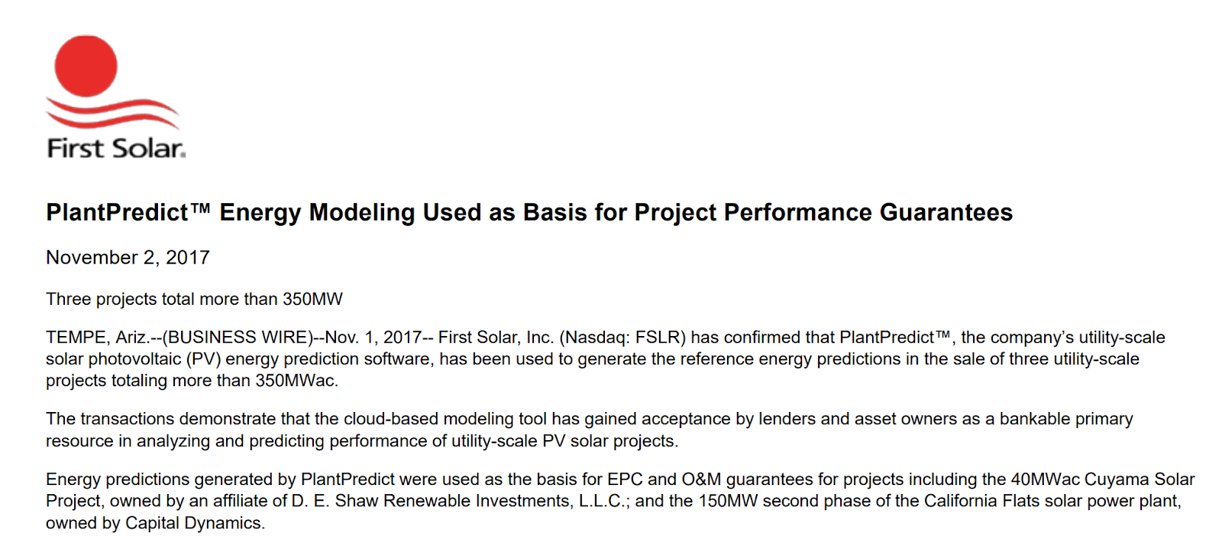
In November 2017, First Solar released a press statement highlighting how PlantPredict was used to generate reference energy predictions for the sale of three utility-scale solar projects, totaling more than 350 MWac. This achievement highlights PlantPredict's reputation among lenders, asset owners, and independent engineers as a reliable, go-to tool for modeling and forecasting performance in large-scale photovoltaic projects.
2. Third-Party Validation: Reviewed by Top IEs
Independent engineers (IEs) such as Black & Veatch, ICF, Leidos, and DNV have reviewed and validated PlantPredict's modeling outputs for financing purposes. If you are a subscriber of PlantPredict, you can access these reports at the PlantPredict resource center.
Third-Party Validation and Benchmarking on Real Data: Independent engineers have compared PlantPredict's modeling outputs with actual plant performance data and, through their technical reviews, confirmed that the platform is able to accurately predict plant performance and energy yield.
Validated Against Industry-Standard Tools: Multiple independent engineers have reported that PlantPredict produces results comparable to or more accurate than those from PVsyst, the current industry-standard tool for solar modeling. Such validation enhances confidence in the platform's accuracy and suitability for utility-scale solar modeling.
Reduces Modeling and Investment Risk: Validation by top independent engineers provides greater confidence since it signifies reduced modeling risk and strengthens the reliability of project performance forecasts.
3. Over 3 Terawatts Simulated: Real-World Confidence
PlantPredict has modeled more than 3 terawatts of solar capacity globally, a scale few platforms can claim.
Diverse Conditions: These simulations span a wide range of climates, geographies, and system configurations, from desert trackers to humid fixed-tilt arrays.
Unified, Reliable Data Ingestion: Automatically imports or calculates all key inputs for accurate modeling — weather data, topography, sun position, equipment specifications, and more — using trusted industry sources (Meteonorm, SolarGIS, Solcast, etc.) matched to the project's location. This minimizes the risk of data mismatches or incorrect inputs.
Advanced Loss Modeling and Reporting: Delivers state-of-the-art loss accounting and a comprehensive energy-yield report that gives investors confidence in the accuracy and completeness of every simulation.
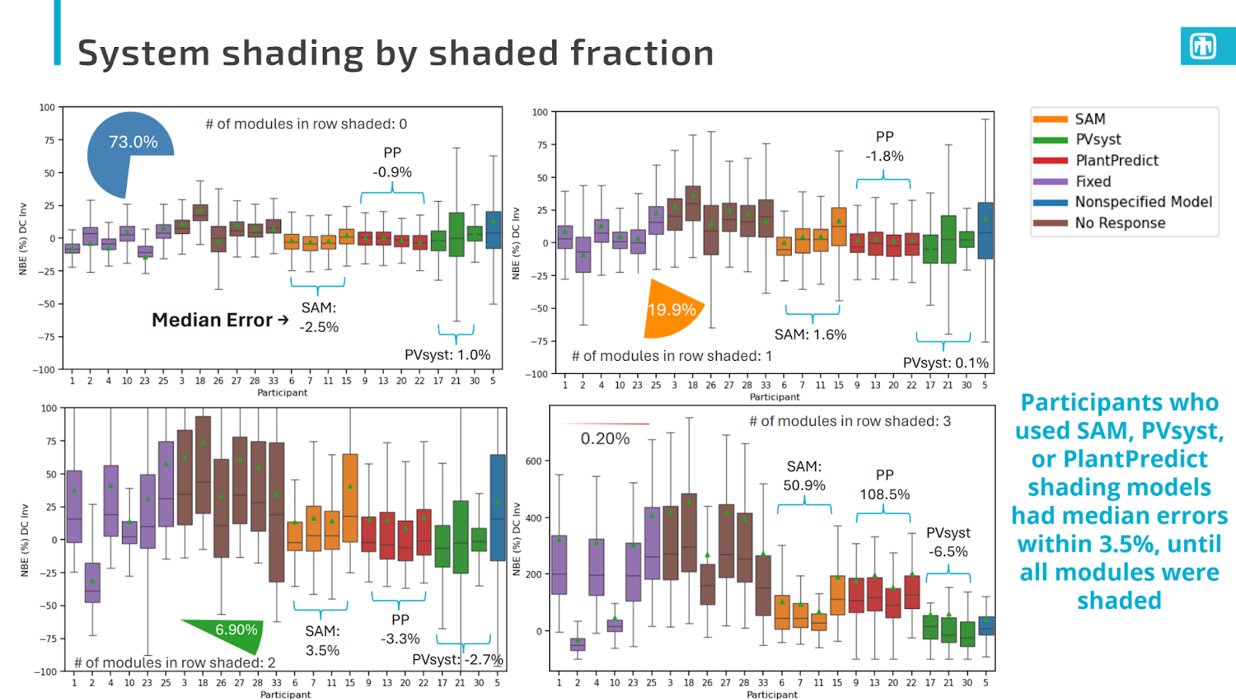
PlantPredict consistently ranks among the top performers in blind modeling competitions hosted by the PV Performance Modeling Collaborative (PVPMC).
No Cherry-Picking: These contests utilize datasets from power plants unknown to the competitors, meaning platforms cannot adjust their models to known outcomes. It serves as a true test of predictive power.
Validated Across Multiple Geographies: The competition evaluated solar projects across varied geographic and climatic settings, confirming PlantPredict's ability to model performance across a wide range of environmental conditions accurately.
Low Error Rates: PlantPredict has demonstrated industry-leading accuracy, with very low mean bias and deviation across multiple blind modeling exercises, aligning closely with measured PV system performance.
PlantPredict brings together a wealth of industry experience, independent validation, and real-world performance to build trust in every simulation. Its proven track record across global projects and industry benchmarks reflects a strong commitment to accuracy and transparency. As solar projects continue to expand in both scale and complexity, tools like PlantPredict will be key players in shaping the future of reliable energy modeling.
Ready to futureproof your modeling workflow?
Join hundreds of organizations that trust PlantPredict for bankable energy predictions. Start with a free account, get a free trial of Pro features, or book a demo with our team.